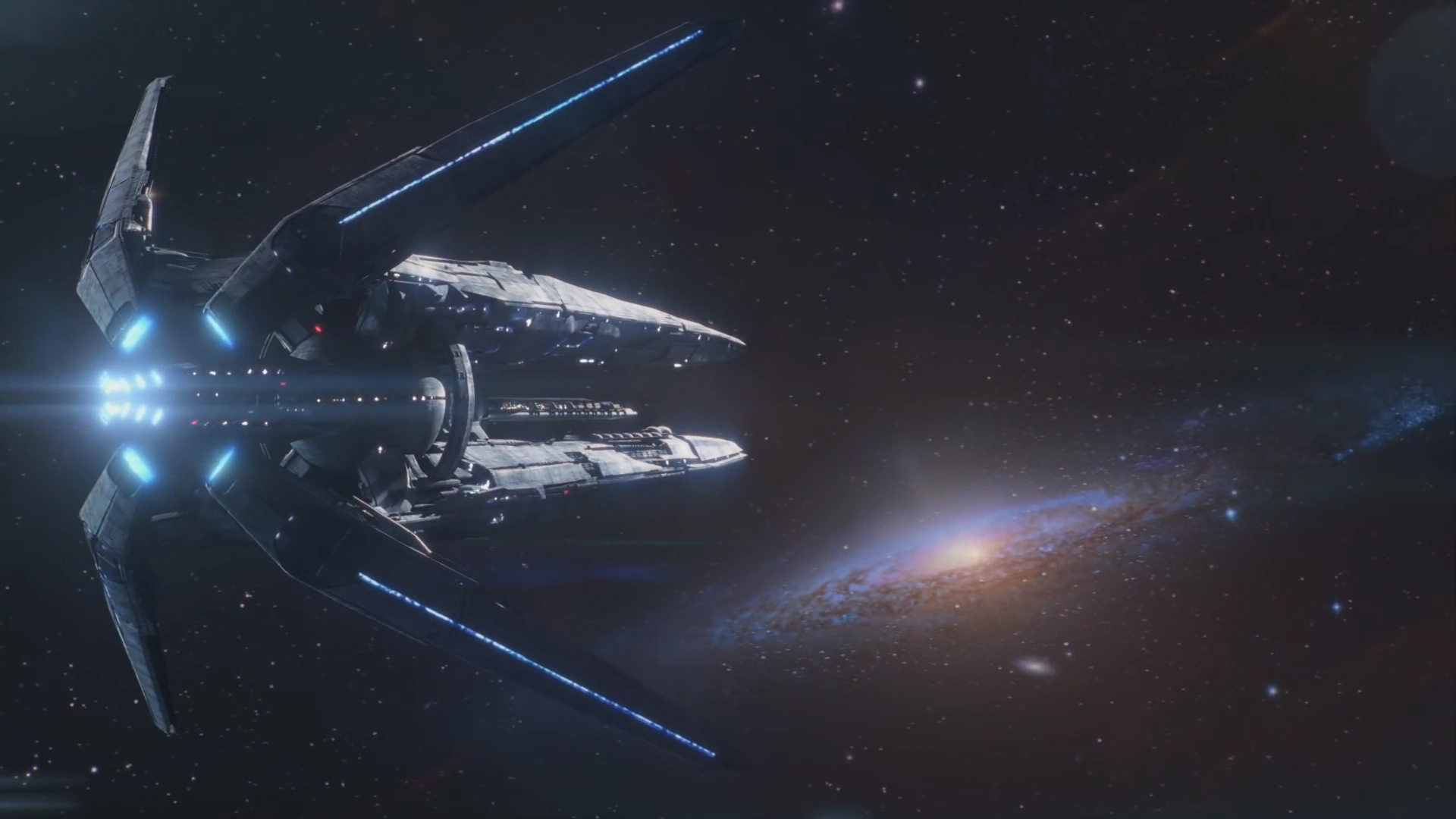
Arks are massive starships that were constructed by the Andromeda Initiative to carry 100,000 volunteer colonists from among the races of the Milky Way to the Andromeda galaxy.
The flagship is called the Nexus, a Citadel-inspired space station designed to be the central support hub of the Initiative and a temporary home for the colonists as they await settlement on one of the selected golden worlds. The other arks are far smaller, with each carrying a separate species. Upon arrival in Andromeda, the Nexus was designed to be expanded to more than double its original size. The other arks would then couple with it to provide additional power and storage.
Technology
Assembled at colossal expense, the arks are a major focus of the Initiative's research and development process, and boast numerous technologies designed specifically to make the journey to Andromeda a reality.
Each ark is massive in scale, with each of the individual vessels comparable in size and tonnage to the dreadnoughts of the Milky Way's various military powers, at around 1.5 kilometers in length each. The Nexus is closer to one of the Wards of the Citadel than an ordinary starship, and considered to be part ark and part space station. Considering their bulk, tram systems are installed to help the crew move between the various sections of the ships.
Because the journey through dark space takes several human lifetimes to complete even with FTL, the arks are equipped with cryostasis pods protected by mass effect fields where the colonists spend most of their time sleeping in until they reach the outskirts of Andromeda.
ODSY Drive System
With the arks unable to refuel by traditional means in dark space, the journey to Andromeda is only made possible by the ODSY Drive System. The ODSY is a massive experimental drive core specifically designed for this trans-galactic voyage. It is capable of recycling static energy that would typically cause a starship to explode, instead storing it to power the ark's primary systems. Meanwhile, an electromagnetic ram-scoop will gather hydrogen from the ark's surroundings, converting it into fuel as needed.

|
“Make no mistake — this is a one-way trip.” — Spoilers for Mass Effect: Andromeda follow. |
|
Mass Effect: Andromeda
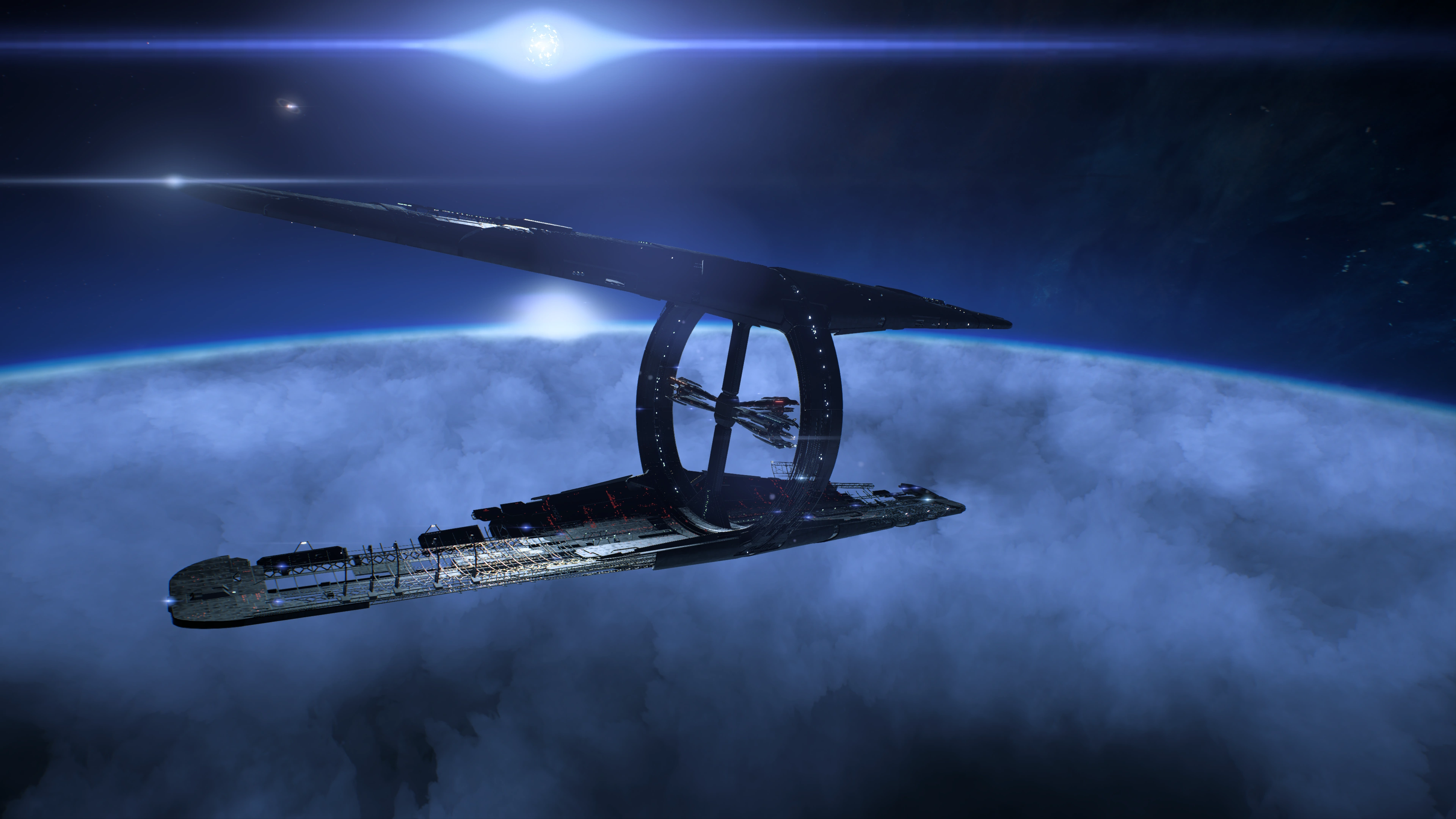
The original plan would have the Nexus and the first wave of arks arrive at the same time, but in reality the arrivals were scattered both in terms of time and location. Ark Hyperion only arrived 14 months after the Nexus. For the rest of the ark fleet, it would take the human Pathfinder and team to recover and bring them back to Nexus: either by rescuing them from kett as in the case of Leusinia and Paarchero, or call in a salvage effort to retrieve the Natanus and its surviving cryo pods.
As massive as the arks are, they are still civilian ships by design and virtue. Even though the arks has some supply of firearms for its security personnel, plus a small fleet of shuttles and fighter crafts, the arks are totally unarmed. Still, the strength of its construction came to display time and again, as proven by surviving a gauntlet through the Scourge, which would typically decimate smaller vessels.
Although the arks were never designed for landing on terrestrial surface, the Hyperion made an emergency crash landing on Meridian, which it managed to come out largely intact, and slated to form the core for the future Port Meridian.
Arks
- First wave
- Nexus - The flagship ark and base of operations for the Andromeda Initiative. Carries members of multiple species, including about 1,200 krogan, the bulk of whom belong to Clan Nakmor. Arrives in Andromeda 14 months before ark Hyperion.
- Hyperion - The human ark. Arrives in Andromeda in 2819 and encounters trouble at Habitat 7. The first ark to successfully dock with the Nexus.
- Leusinia - The asari ark. Chased and damaged by kett, with about 8,000 stasis pods emptied to evacuate their occupants. Found in Valay.
- Natanus - The turian ark. Heavily damaged by the Scourge, with 4,628 stasis pods ejected across Heleus by the ship's SAM. Found in Remav.
- Paarchero - The salarian ark. Captured by kett, with several thousand stasis pods taken and emptied for experimentation. Found in Tafeno.
- Second wave
- Keelah Si'yah - The quarian ark, also designed to carry drell, hanar, batarians, elcor and volus. The varied biological needs of this ark's population created technical complications, so its launch was delayed until after the first wave's departure. It is not expected to arrive in Andromeda for some time. It is later discovered that the Keelah Si'yah did indeed make it to Heleus, after Pathfinder Ryder hears a distress call from the ark. The location of the quarian ark was not broadcasted, as it is currently unsafe for an unknown reason.